The Next Automotive Cyberattack Won’t Target a Vehicle
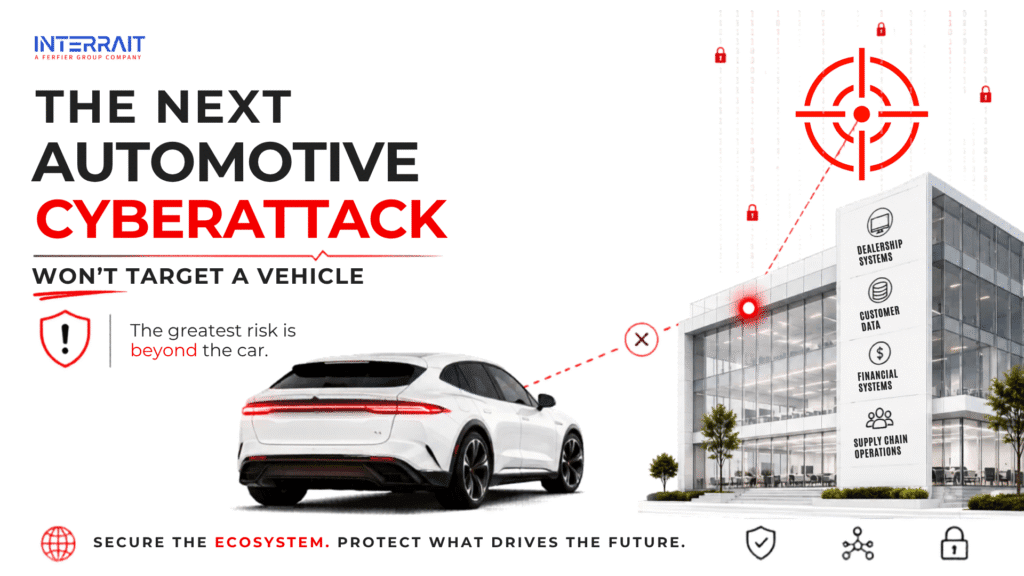
For more than a decade, automotive cybersecurity discussions have been dominated by a single question:
What happens if someone hacks the vehicle?
It’s an important question. Connected vehicles, over-the-air updates, autonomous capabilities, and software-defined architectures have fundamentally changed the risk landscape for manufacturers and suppliers alike.
But while much of the industry remains focused on securing the vehicle, a different threat is quietly emerging.
The next major automotive cyberattack is unlikely to target the vehicle itself.
It will target the systems that keep vehicles moving.
The New Crown Jewels of Automotive
For many automotive organizations, the greatest operational dependency is no longer the production line—it’s the technology ecosystem that supports it. Parts management platforms, warranty systems, dealer applications, cloud environments, and supplier integrations now influence everything from customer satisfaction to revenue recognition. A disruption to any one of these systems can create consequences far beyond the IT department.
Consider what powers a typical automotive enterprise today:
- Parts forecasting and inventory management platforms
- Warranty administration systems
- Dealer portals
- Supplier collaboration platforms
- Service scheduling applications
- Customer engagement systems
- Connected data platforms
- AI-powered analytics and reporting tools
These systems are increasingly interconnected. Data flows continuously between OEMs, suppliers, dealers, logistics providers, and technology partners.
In many cases, a disruption to these operational platforms would have a more immediate business impact than a disruption to the vehicle itself.
Attackers understand this.

Why Attack the Vehicle When You Can Stop the Business?
Cybercriminals are increasingly motivated by financial gain, disruption, and leverage.
That changes the economics of an attack.
Compromising a vehicle is difficult, highly specialized, and often delivers limited financial value.
Disrupting the systems that support thousands of vehicles, however, is a different story.
Imagine the impact if:
- Dealers lose access to service scheduling systems.
- Parts inventory data becomes unavailable.
- Warranty claims processing is interrupted.
- Supplier communications are disrupted.
- Customer service platforms go offline.
- Operational data is encrypted or manipulated.
The result is not simply an IT issue.
It becomes a business continuity one.
Vehicles may continue to sit on lots or in customer driveways, but the processes that support sales, service, repairs, and customer satisfaction begin to slow—or stop entirely.
Automotive’s Growing Dependency on Digital Operations
Over the past several years, automotive organizations have accelerated investments in cloud platforms, digital transformation initiatives, predictive analytics, and AI-enabled processes.
The benefits are significant.
Organizations gain greater visibility into inventory, improved forecasting accuracy, faster warranty processing, and enhanced customer experiences.
But digital efficiency comes with a tradeoff: operational dependency.
Many critical business processes now rely on systems that were never originally designed with today’s threat landscape in mind.
Legacy applications have been integrated with modern platforms. New APIs connect systems across departments and organizations. Vendors gain access to sensitive operational environments. Data is shared across increasingly complex ecosystems.
Every new connection creates value.
Every new connection also creates risk.
The AI Layer Changes the equation.
The rise of AI introduces another dimension that many organizations are still evaluating.
Across the automotive sector, AI is being used to automate workflows, improve forecasting, analyze warranty data, support customer service, and assist decision-making.
The conversation often focuses on the capabilities of AI.
The more important question may be access.
An AI agent that can retrieve inventory data, analyze warranty claims, access dealer information, and generate operational recommendations becomes extraordinarily valuable.
It also becomes a highly attractive target.
Organizations are beginning to recognize that AI security is not simply about protecting models. It is about protecting identities, permissions, data access, integrations, and the broader ecosystem that enables AI to function. As AI adoption expands, cybersecurity leaders must ensure governance evolves alongside innovation.
The Supply Chain Is Now Part of Your Security Perimeter
The automotive industry has always depended on partnerships.
Today’s digital ecosystem extends that dependency further than ever before.
Manufacturers rely on suppliers. Suppliers rely on software providers. Dealers rely on manufacturers. Customers interact through multiple digital touchpoints throughout the ownership journey.
The challenge is that attackers only need to identify one weak link.
A vulnerability introduced through a third-party integration, vendor account, cloud platform, or supplier connection can create exposure across a much larger ecosystem.
This reality is forcing organizations to rethink cybersecurity from a broader perspective.
The question is no longer: “Are our systems secure?”
The question is: “How resilient is the entire ecosystem we depend on?”
What Automotive Leaders Should Be Asking
As cybersecurity increasingly intersects with operations, leadership teams should begin evaluating risk differently.
Instead of focusing solely on traditional security controls, organizations should ask:
- Which systems are most critical to daily operations?
- What would happen if those systems became unavailable tomorrow?
- Which third parties have access to sensitive environments?
- Where does operational data flow across the organization?
- How are AI initiatives changing access and permissions?
- How quickly could we detect and contain a disruption?
The answers often reveal exposures that are not visible through traditional security assessments alone.
Cybersecurity Must Be Operationally Informed
Effective cybersecurity requires more than technical expertise. It requires understanding how the business operates.
Protecting a dealership ecosystem requires different considerations than protecting a manufacturing environment. Securing a warranty platform presents different challenges than securing customer-facing applications. Managing risk across a supplier network demands visibility that extends beyond organizational boundaries.
This is why industry context matters.
Organizations need security strategies that align with operational realities—not generic checklists.
The Road Ahead
The automotive industry will continue to invest in connected experiences, AI-driven operations, cloud technologies, and digital transformation initiatives.
These innovations will create enormous opportunities for growth and efficiency.
They will also create new pathways for cyber risk.
While headlines may continue to focus on connected vehicles, the greater business threat may lie elsewhere—in the operational systems that support the entire automotive ecosystem.
The organizations that thrive over the next decade will not be those that simply deploy more technology.
They will be those that build resilience into the systems, processes, and partnerships that power modern mobility.
Is Your Automotive Ecosystem Secure?
Many automotive organizations invest heavily in protecting networks, endpoints, and compliance requirements while overlooking the operational systems that support warranty management, parts operations, dealer communications, supplier collaboration, and emerging AI initiatives.
At InterraIT, we combine deep automotive industry expertise with modern cybersecurity capabilities to help organizations identify hidden risks, strengthen resilience, and secure critical business operations.
Whether you’re evaluating cloud security, identity management, managed security services, AI security, or broader cybersecurity governance, our team can help you uncover vulnerabilities before attackers do.
Learn more about InterraIT’s Cybersecurity Services and discover how we help automotive organizations secure innovation without sacrificing operational performance.
